By New Consumption Research Institute
For years, the domestic beauty device market has flourished, with numerous brands emerging like mushrooms after rain. While offering consumers abundant choices, it has also faced the pain points brought by "unregulated growth."
Market research shows that in the Chinese market, the beauty device e-commerce sector has demonstrated strong growth momentum. In 2023, the scale of China's beauty device market reached approximately 18.37 billion yuan, a year-on-year increase of 70%, and is expected to exceed the 20 billion yuan mark by 2026.
However, with the continuous strengthening of regulatory efforts in the past two years, a series of relevant standards and regulations have been introduced, providing strong guarantees for the healthy development of the industry. China's beauty device industry has gradually moved towards standardization, and the market has ushered in unprecedented changes, placing higher demands on players in this sector.
In October this year, radio frequency (RF) skin treatment devices from domestic beauty device brands AMIRO and Marie Belle received national Class III medical device certification. This marks the first batch of "licensed" products since RF skin treatment devices were included under Class III medical device supervision in March 2022, signaling a new stage of development for the beauty device industry.
In recent years, the National Medical Products Administration (NMPA) and other regulatory bodies have issued a series of regulations and standards for home beauty devices, clarifying the regulatory requirements for RF treatment devices and RF skin treatment devices. Starting from April 1, 2024, RF treatment devices and RF skin treatment devices that have not obtained medical device registration certificates shall not be produced, imported, or sold.
Although the implementation of this policy has been postponed to April 2026 due to the limited number of brands that have obtained medical certification, this delay provides a certain buffer for companies in the industry. It also indicates that under the future regulatory environment, brands must increase R&D efforts to ensure compliance with new medical standards.
With AMIRO and Marie Belle's RF beauty devices taking the lead in obtaining certificates in October and launching during this year's "Double 11" shopping festival, the RF beauty device industry, which has experienced turbulence due to policies, is facing a new landscape and will usher in a new round of market competition. Although the two-year regulatory grace period has somewhat diminished the first-mover advantage of brands that have already obtained dual certificates, the direction of industry development is now clear.
The New Consumption Research Institute noted that the first batch of certified beauty device brands have already started product promotions. Marie Belle has put a "licensed to work" label on e-commerce platforms and uses the prominent slogan "the first in the country with dual Class III medical device certificates" in its marketing. Meanwhile, AMIRO has hung a banner announcing "one of the first batch nationally to obtain certification" in its live-streaming rooms and is vigorously promoting on e-commerce platforms.
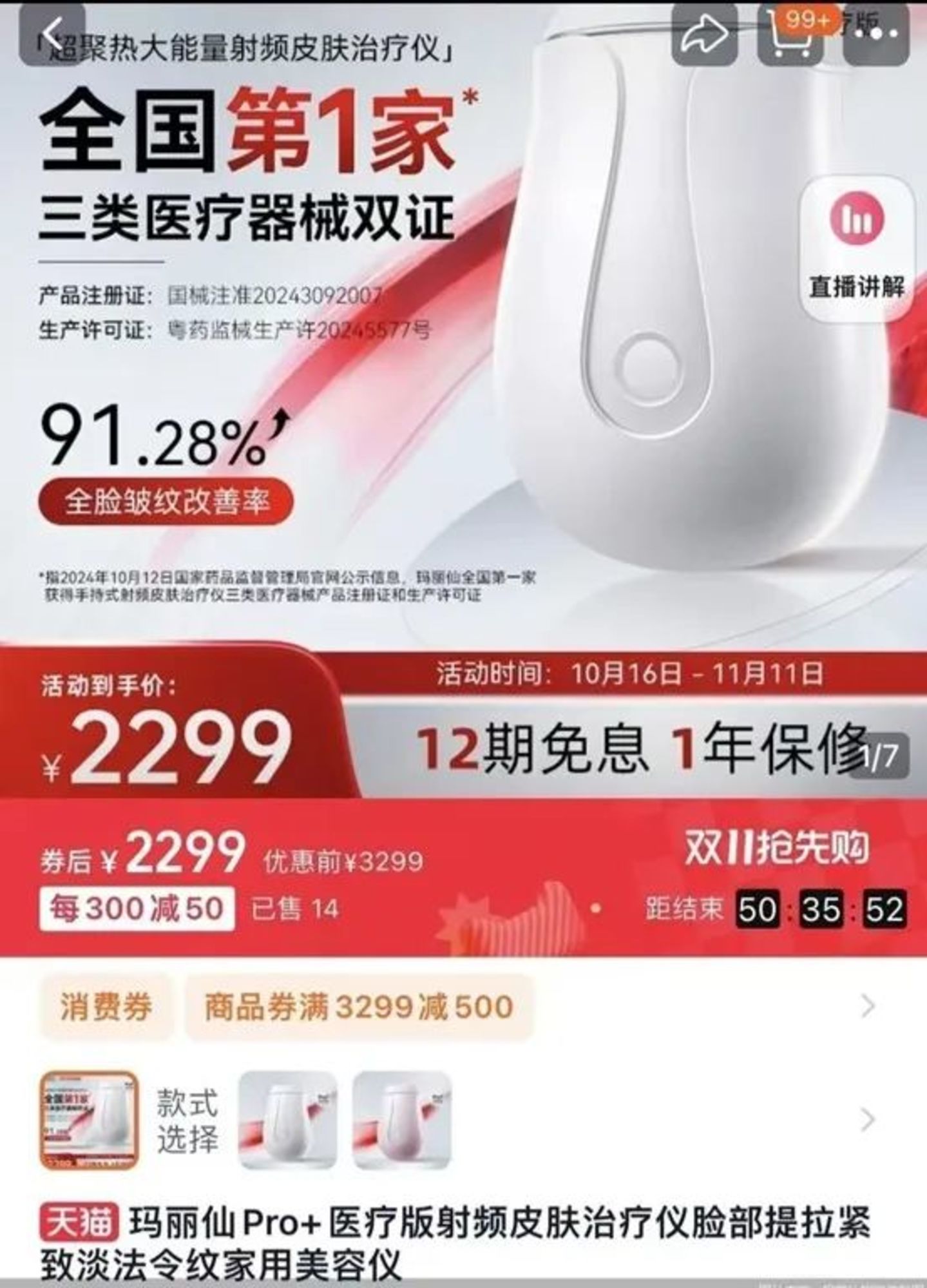
It is understood that the Class III medical device registration certificate is specifically for the registration and management of high-risk medical devices. It requires full lifecycle supervision of product design, materials, production, sterilization, packaging, storage, transportation, operation, and use, and adopts scientific and reasonable methods to analyze and evaluate clinical data to ensure the safety and effectiveness of the medical device within its applicable scope. Due to the extremely high difficulty and complexity of obtaining the certificate, although several brands had previously announced that they had entered the final review stage earlier this year, it was not until October that the first batch of brands announced they had obtained certification.
Huang Yanting, Operations Director at Yushi Technology, believes that the difficulty of applying for a Class III medical device certificate is very high, posing a significant test for a brand's R&D capabilities, management abilities, and financial resources. Although the policy adjustment has created a new buffer period, which has somewhat weakened the early-mover advantage of those who have obtained dual certificates, the certification process takes a long time, and the number of companies that can obtain the certificate this year is expected to be in the single digits.
It can be seen that the home beauty device industry is moving from being "marketing-driven" to being "R&D and product strength-driven." Certified products will gain long-term competitiveness and drive this market segment to gradually recover from its trough.
However, a look at major e-commerce platforms and live-streaming rooms reveals that a large number of RF beauty devices that have not yet obtained Class III medical device production licenses remain popular, with strong promotion and sales efforts, which to a large extent overshadows the buzz around the first batch of "licensed" beauty devices.
In fact, when consumers choose beauty devices, having a certificate is not the primary factor, and beauty device marketing has once again fallen into chaos.
Huang Yanting candidly stated that due to the impact of the new regulations, the beauty device industry experienced significant price drops starting from the beginning of this year. Even though the transition period was extended in July, there has been no noticeable rebound in overall market sales. After experiencing turbulence, consumers are more inclined to wait and see, maintaining a rational consumption mentality.
Looking back at the development of China's home beauty device industry, from 2014 to 2016, it was a period of chaotic exploration, with a large number of high-end overseas beauty devices entering the Chinese market. In 2017, Tmall.com officially included beauty devices in the beauty category, marking the first year of development for the home beauty device industry. From 2018 to 2023, the industry experienced a new stage of development with the strong rise and counter-attack of domestic beauty devices.
Over the years of development, home beauty device brands have gradually formed a marketing landscape dominated by online channels while actively expanding offline markets.
Since the beginning of this year, due to the implementation of new regulations on RF beauty devices and changes in the consumption landscape, the beauty device sector has faced transitional pain, with online sales gradually declining. In the first quarter of 2024, online sales volume in this category decreased by 32% year-on-year, and sales revenue decreased by 43% year-on-year. However, data analysis from brand sales platforms shows that although the online market size for beauty devices has shrunk compared to before, the main sales battlefields for 20 beauty device brands remain concentrated on Douyin (TikTok) and JD.com.
Among them, sales volume on the Douyin platform is still growing. Market statistics show that in the first quarter of 2024, Douyin's GMV exceeded 10 billion yuan, a year-on-year increase of 92.84%. Over the past 13 months, the overall sales trend of beauty devices on Douyin has been stable, with average monthly sales exceeding 770 million yuan.
At the same time, during the market's new regulatory buffer phase, beauty device brands are also developing their own advantageous product categories and actively seizing offline markets through product innovation, laying the groundwork for the future.
For example, domestic brands GEMO and JOVS actively responded to the new regulations, focusing on LED light technology and photoelectric technology as their main products, quickly adapting to market demand. Meanwhile, GEMO has entered numerous high-end offline shopping malls in China, including Shanghai Daimaru Department Store, Beijing New World, Hangzhou MixC, and Sanya Haitang Bay.
It is evident that driven by industry standardization, the competitive landscape of the beauty device market is also changing. On the one hand, international brands such as Ya-Man, ReFa, Panasonic, and Tripollar have significant advantages in technological R&D, quality control, and brand promotion, occupying the high-end market share. On the other hand, well-known domestic brands like AMIRO and GEMO are demonstrating positive growth momentum through cost-effective advantages and localized service strategies.
Industry insider Li Miao pointed out that China's beauty device market is continuously expanding and undergoing technological elimination. Mastering technology is the foundation of a brand's vitality. During the market's new regulatory buffer period, the right path for beauty device brands is to obtain Class III medical device certification as soon as possible. It is difficult for brands to truly save themselves if they only use the buffer period to intensify marketing efforts in order to quickly sell off inventory.
As competition intensifies in the beauty device market, some brands inevitably engage in irregular practices such as exaggerated marketing and even false advertising, and cases of marketing "backfiring" are not uncommon. This not only harms consumer rights and interests but also negatively impacts the image of the entire domestic beauty device industry.
Previously, ReFa beauty devices were fined 450,000 yuan by the Shanghai Pudong New Area Market Supervision Administration for suspected false advertising. Specifically, ReFa mentioned information such as "recommended by Japanese anti-aging experts" in its promotions, but upon verification, such recommendations did not exist.
Similarly, during the 2023 Double Eleven period, another well-known beauty device brand, AMIRO, experienced a major public relations incident. It was exposed that the online price of the same product was 1,600 yuan higher than the offline price, leading to accusations of "price fraud" and "fleecing customers." The huge price difference between different channels led to a significant decline in consumer trust in the AMIRO brand, severely impacting its brand image.
It is worth noting that during the two-year regulatory buffer period, some beauty device brands that have not yet obtained certification or may not be able to obtain it are also increasing their promotional efforts, trying to use the buffer period to quickly sell products, even resorting to exaggerating efficacy to mislead consumers, leading to frequent product quality and even safety issues.
For example, Wali Bao (Shanghai) Beauty Instrument Co., Ltd. was fined over 1.5 million yuan in 2022 for selling unqualified Zeus beauty devices. In July 2022, Tripollar recalled over 180,000 products due to the safety hazard of burns. In 2022, after comparative testing, the Shenzhen Consumer Council found that six popular beauty devices on e-commerce platforms, including ReFa and Ya-Man, had high nickel release levels that could cause skin allergies. In June 2023, the Shanghai Market Supervision Administration released the results of a spot check on beauty care appliances, with brands such as Tripollar, JUJY, and Yaxing appearing on the list of quality violations.
On platforms like 12315 and Black Cat Complaint, there is no shortage of consumer complaints regarding the quality, safety issues, false advertising, exaggerated efficacy, and other aspects of beauty devices. For example, the well-known Japanese beauty device brand Ya-Man was complained about by users for false advertising. One user claimed that after using the Ya-Man green light mask for a month, not only did it not whiten or remove spots, but their spots became more noticeable.
Observing user comments on several mainstream e-commerce platforms reveals even more startling situations. Many users report that the beauty devices they purchased are of poor quality, involve exaggerated advertising, or even have problems such as electric leakage, burns, causing allergies and acne. Furthermore, they are often unable to resolve issues with the brands after discovering the problems, and sometimes have no way to seek redress.
The industry's long-standing irregularities and disorderly efficacy claims have also made many consumers wary of home beauty devices, affecting the overall healthy upward development of the market.
In this regard, one industry expert believes that the standardized development of the domestic beauty device industry is a long-term and arduous task. Only through the joint efforts of market regulatory authorities, brands themselves, industry associations, and the media can the entire industry develop in a healthier and more orderly direction. At the same time, consumers should maintain a rational consumption mindset, choose products through formal channels, and avoid being misled by false advertising.