The irreplaceable value of a product manager is the ability to accurately identify and meet user needs, translate those needs into products, coordinate resources to drive product implementation, and create business value.
In recent years, consumers' demand for beauty and personal care has become increasingly refined, giving rise to many segmented categories. After more than ten years of market education, what are the demands of consumers for beauty devices, and what is the competitive situation of the beauty device market? Beauty devices lead the personal care small home appliance race — what are the brand's growth strategies?
Personal protective small appliances are definitely one of the strongest categories in the small appliance market.
Firstly, in recent years, consumers' personal care needs have become increasingly refined, giving rise to more and more opportunities for segmented product categories. From 2017 to 2022, the e-commerce penetration rate of China's personal care equipment market increased from 43.8% to 62%. The categories of water flossers, waist and neck massagers, hair dryers, skin shovels, facial wash devices, hair removal devices, beauty devices, etc., are moving towards greater convenience, intelligence, and comfortable experience.
Especially beauty and body care devices such as beauty and hair removal machines have shown very good growth performance across all channels. From 2019 to 2022, traditional e-commerce channels such as Tmall, JD.com, and other beauty and body equipment increased from 7.6 billion yuan to 11.9 billion yuan, with a compound growth rate of 16.35%. Taking TikTok as an example in live broadcast e-commerce, its sales of beauty and body care instruments reached 3.269 billion yuan in 2022, with a year-on-year growth of 102.22% in 2022Q4.
Beauty devices entered the domestic market around 2010, and after several product iterations and consumer education, they have now entered a stage where domestic substitution has gradually become mainstream and the dominance of overseas big brands has loosened.
The outbreak of beauty salons in recent years also benefited from more stringent face value management of consumers. Research from clove doctors and iResearch shows that a large proportion of consumers with anti-aging needs or light medical experience will choose beauty salons as a normalized anti-aging product.
So, after more than ten years of market education, what are the demands of consumers for beauty devices, and what is the competitive situation of the beauty device market? What opportunities do domestic brands have to overtake in such a category with high technological barriers and average customer orders?
1. What are the driving factors for household beauty devices to become a star category for small household appliances?
Personal care small appliances have been one of the fastest-growing segments in the home appliance industry over the past five years, especially during the three years of the pandemic.
According to Euromonitor, in 2017/2018/2019/2020/2021/2022, the market size of personal care small appliances reached 277/309/343/359/367/389 billion yuan respectively, with an average annual compound growth rate of 7.04%.
In the field of personal care small appliances, beauty devices, hair removal devices, and hair dryers are the largest and fastest-growing categories in the market, with beauty devices accounting for 51.75% and hair removal devices accounting for 33.1% in 2022.
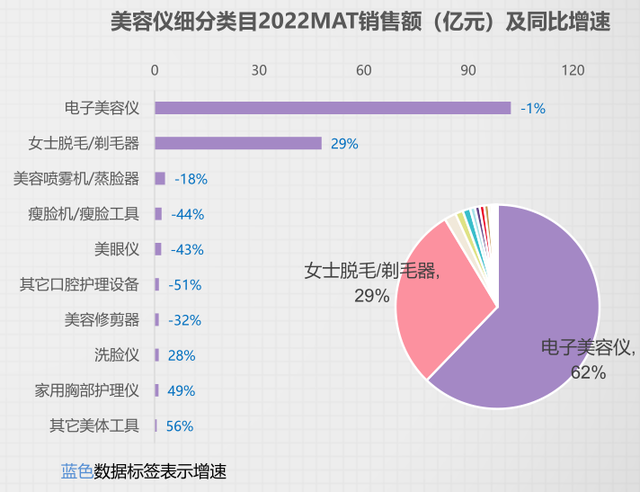
Source: Magic Mirror Market Intelligence Research
Unlike the rapidly growing but rigid demand for cleaning small appliances, personal care small appliances are an upgraded demand type product (non-essential) aimed at improving the quality of life, driven by consumers' greater emphasis on appearance management.
In the field of personal care and small home appliances, taking the category of beauty devices as an example, which has the largest market capacity and second only to hair removal devices in terms of market growth rate, due to its combination of skincare products and small home appliances, beauty devices were the only subcategory in the beauty and personal care sector to maintain an increase in food ingredient share during last year's Double Eleven period.
At the same time, whether for practical efficacy or in consumer perception, existing home beauty products will have associated consumption with common skincare products/light medical beauty, which is a manifestation of consumers using more comprehensive and refined means to manage their appearance:
1. Consumers with anti-aging needs will upgrade and supplement the beauty instrument as skin care products
Anti-aging needs tend to be younger and more daily. The main age group for anti-aging is between 18-35 years old, but 25 years old is a watershed. Young people under 25 years old (post-95s, post-00s) have a growing awareness of anti-aging, while after 25 years old, most of them have mild mature and mature skin. The speed of facial collagen synthesis slows down, and wrinkles, yellowing, sagging, and sensitivity are the main skin problems they face.

Source: Dr. Dingxiang
According to the Research on Cognition of Household Beauty Instrument and anti-aging Consumer Behavior by Doctor Lilac, 85% of consumers with anti-aging needs will choose functional skin care products, and 20% will try household beauty instruments.
2. Consumers who have a habit of regularly undergoing light medical beauty treatments will use beauty devices as a means to maintain and care for them
What is light medical beauty? According to iMedia data, non-surgical light medical beauty projects include injection based (hyaluronic acid, botulinum toxin, collagen, etc.), laser based (photon rejuvenation, Thermage, Thermage lifting), and others (skin/body care, thread carving). These projects have minimal trauma and fast recovery, and in 2021, non-surgical medical beauty projects accounted for 52%.
According to iResearch's research, the most preferred product information for users considering purchasing home beauty devices includes: 20% want to know if/how medical beauty and beauty devices can be combined, and 48% want to know under what circumstances/skin conditions beauty devices cannot be used; More than 36% of medical beauty consumers purchase beauty devices as a response to skin aging.
In fact, when the epidemic caused a huge impact on the offline beauty service industry, it also stimulated consumers' demand for home use of beauty salons. With more sophisticated facial management and anti-aging needs, home beauty salons have successfully become the most promising segment of small household appliances/skin care consumer goods.
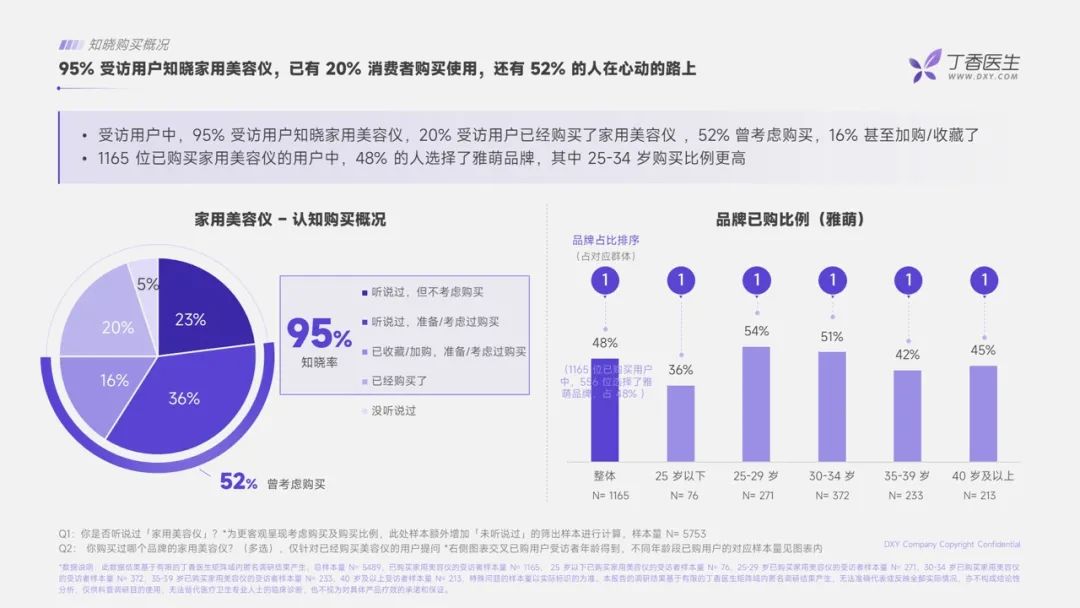
Source: Dr. Dingxiang
2. As a category with high technological barriers and high customer orders, how can brands tap into market potential for beauty devices?
It can be seen from the above that the household beauty instrument itself has strong functionality (focusing on specific beauty functions: anti-aging), high technical barriers (involving skin, photoelectric, chemical, biological engineering technology), high customer order (mainstream price is 2k-5K) and other categories of genes, and it is also a personal care demand driven by the beauty economy to improve the quality of life.
1. RF beauty devices with comprehensive functions have become mainstream, and there is still room for iteration in product technology
From the perspective of industry development, since Panasonic's introduction of beauty devices into the Chinese market in 2010, beauty devices have gone through the stage of market education and popularization. However, beauty device products still have a lot of room for iteration (whether it is technological optimization or meeting user pain points).
At present, household beauty devices are mainly equipped with three mainstream technologies: radio frequency, microcurrent, and light. Among them, radio frequency technology has been proven by the medical community to have the effect of achieving facial rejuvenation. Radio frequency beauty devices with a unit price of over 2500 yuan have already occupied more than 80% of the market share. According to Gfk Zhongyikang, in recent years, basic skincare electronic beauty devices are no longer popular among consumers, and comprehensive skincare RF devices are the main trend.
The principle of the radiofrequency beauty device is that radiofrequency acts on the skin, and the heat generated by electromagnetic waves can heat the dermis layer. After heating, the collagen under the skin will contract and tighten, and promote the regeneration of collagen cells.
EMS microcurrent technology is also capable of addressing issues such as collagen loss and skin sagging. It uses weak current to stimulate muscles and lymph nodes, achieving effects such as muscle contraction, edema reduction, and skin tightening. Its representative product is the facial massager.
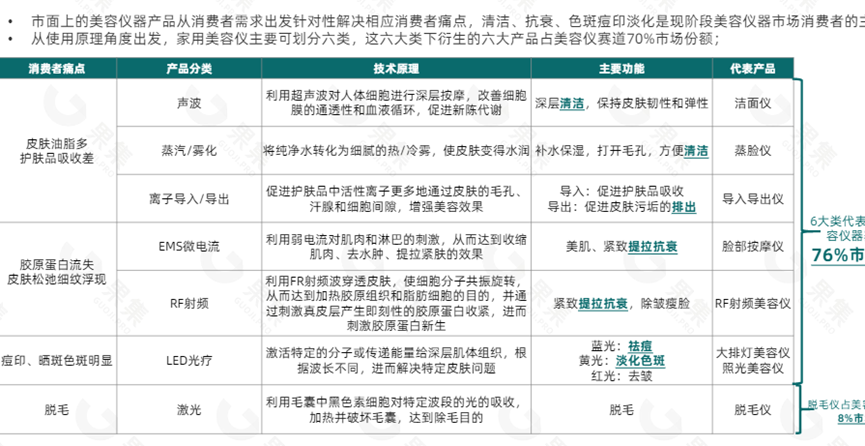
In addition, to solve different skin problems of consumers, common technologies and corresponding functions used in home beauty devices on the market also include: laser (hair removal), LED phototherapy (yellow light fading spots, blue light acne removal, red light wrinkle removal), steam/atomization (cleaning pores, moisturizing), sound waves (deep cleaning, maintaining skin elasticity), ion import/export (promoting skin care product absorption and dirt removal).
2. The industry landscape presents a trend of domestic substitution, with mainstream prices concentrated upwards
In addition to changes in products and technology, the landscape of the beauty device industry is also undergoing a reshuffle, with emerging domestic brands gradually breaking the monopoly of overseas brands.
Although overseas brands led by YAMAN dominate the electronic beauty device market due to their brand positioning and technological barriers, domestic brands are gradually increasing their contribution to the 1.5-5k price range where competitors are concentrated due to their cost-effectiveness advantage. According to Magic Mirror data, after 2021, the competitive price range for beauty devices has shifted from 1.5-5k to 3k-4k with greater precision, and consumers are more inclined towards higher priced products.
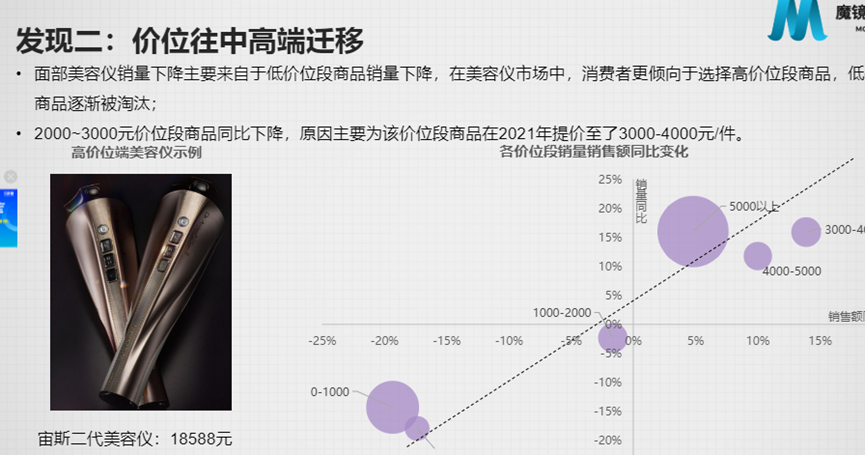
Among them, domestic emerging brands such as FLOSSOM, AMIRO, and Ulike have emerged. According to Magic Mirror data, the market share occupied by domestic brands has increased from 21.8% to 35.8% in 2021-2022. During last year's Singles' Day holiday, domestic brands had already occupied three of the top 5 sales positions in the household beauty device category.
3. Core strategy for brand growth: Increase R&D investment and communicate with users
From the perspective of market strategy, brands not only need to strengthen research and development investment, but can also focus on improving efficiency, user convenience, and intelligent experience in specific facial areas to enhance technological barriers.
For example, a product with the model YAMAN YJFS16RF, called the Golden Ring RF Generator. This product will occupy a market share of up to 10.2% in the electronic beauty device market from July to December 2022. As an upgraded version of YAMAN PRO, it has more comprehensive and powerful functions: it can target facial areas including fading forehead wrinkles, reducing eye wrinkles, lifting jawlines, and comprehensively deal with the problem of loose/drooping/wrinkled skin.
At the same time, two skincare modes are also designed to meet consumers' "lazy skincare" needs: the 6-minute lazy mode can gradually establish skin tolerance, and the 10 minute POWER mode can adjust the output energy wave according to different skin conditions.
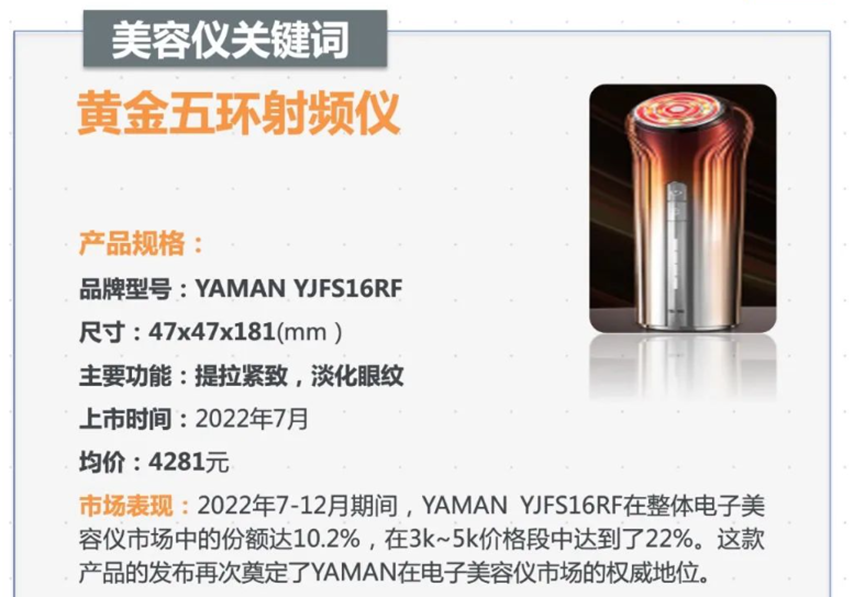
The powerful skincare functions and intelligent temperature control technology mentioned above have enabled the Golden Ring RF generator to achieve a market share of 22% in the 3k-5k price range.
On the other hand, many reasons such as unfamiliarity with the field of beauty device technology, high customer demand, and non-essential needs make users' decision-making time longer. Brands need to strengthen communication with users, transform the working principles of home beauty devices across multiple disciplines such as dermatology, clinical medicine, optoelectronics, biology, etc., into easy-to-understand popular science information, establish industry standards for consumers to distinguish between good and bad products, establish a professional image of the brand, and reduce its decision-making costs.
For example, live streaming e-commerce is the most frequently mentioned channel by consumers. In addition to the low prices or gifts in the live streaming room, the trust halo that the anchor brings will further reduce consumers' decision-making costs.
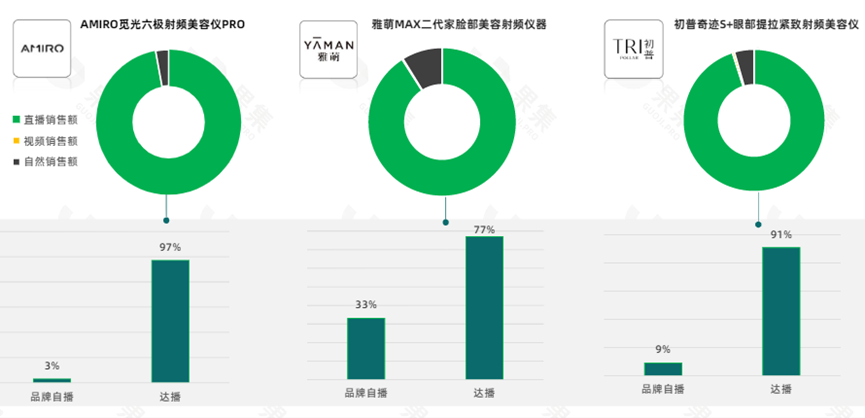
An interesting phenomenon is that during last year's Singles' Day, the star products of top brands such as Miguang Level 6 RF, Yameng Max Second Generation, and Chupu Miracle S+Eye Lifting RF Beauty Device were mainly contributed by influencers, with Yameng, the brand with the highest self-broadcasting contribution rate, accounting for only 33%.
But different from the marketing method commonly used in the skin care industry, the beauty instrument, as a kind of medical device, will also choose some healthy and medical KOLs, such as clove doctor, to launch in addition to conventional grass planting such as Xiaohongshu and Tiktok, so as to enhance the professionalism and safety of the product.
Source official account: Community Marketing Research Institute (ID: Community_Marketing), insight into community consumption.
This article is authorized to be published by the collaborative media @ Community Marketing Research Institute of Everyone is a Product Manager. Reproduction without permission is prohibited.
The title image is from Unsplash, based on the CC0 protocol.
The viewpoint of this article only represents the author himself, and everyone is a product manager. The platform only provides information storage space services.


