 Songguo Finance
Image credit @Visual China
By Songguo Finance, Author: Ning Que
As office workers increasingly suffer from physical pains, the massage器具 market has grown accordingly.
Portable massager leader Breo has already opened 153 direct stores with revenue exceeding 100 million yuan. After submitting its prospectus last June to officially impact the STAR Market IPO, on September 29, Shenzhen Breo Technology Co., Ltd. (hereinafter "Breo") saw its listing status on the Shanghai Stock Exchange changed to "inquired".
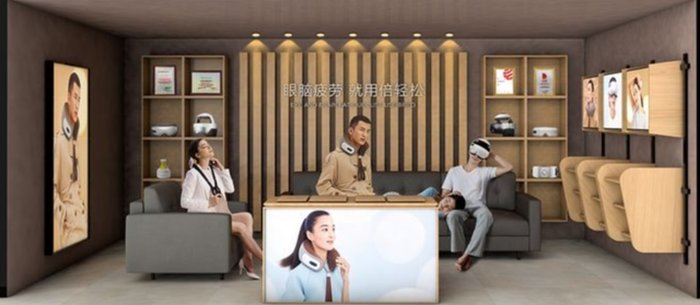
Barring any surprises, Breo will land on the STAR Market, becoming the "first intelligent portable massager stock." Apart from favorable health-sector trends, what other factors are driving Breo's IPO path? And if successfully listed, what will the company's future prospects be?
With so many massager players, why is Breo able to pioneer an IPO?
Founded in 2000, Breo specializes in the design, R&D, production, sales and service of intelligent portable massagers. According to the prospectus, Breo mainly operates its own brands "breo" and “Breo” series products, while also providing ODM customized products for other companies. It has gradually formed a product system dominated by four major categories: eye, neck, head and scalp massagers.
Breo's primary revenue source is its own-brand "breo" and "Breo" product lines, which contribute more than 90% of total operating income. Prospectus data shows that from 2017 to 2019, the share of the four core self-brand product categories in main business revenue was 73.76%, 76.35%, and 80.13% respectively, showing an upward trend year by year.
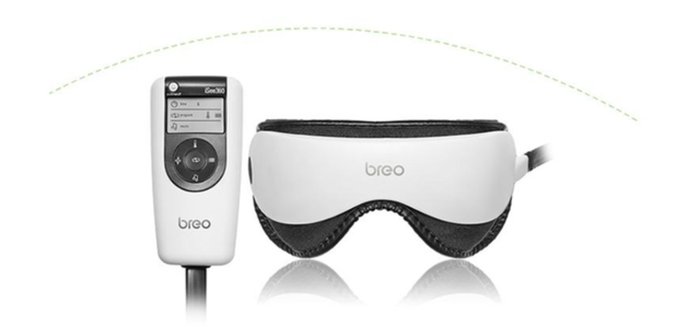
Among them, the eye massager, which served as Breo's entry product, has accounted for nearly 30% of main business revenue over the years. At the same time, the share of neck and scalp massagers has also increased significantly.
Affected by the pandemic, Breo actively shifted online, successively entering e-commerce platforms such as Tmall and JD.com. According to the prospectus, in 2019 Breo’s online and offline sales accounted for 40.26% and 54.03% respectively, gradually balancing the two channels.
So, among numerous massager players, why is Breo able to be the first to go public? And why has it chosen this timing for its IPO?
(1) Capturing the massager niche to create differentiated competition. From the start, Breo focused on portable massagers as its entry point, targeting eye, head, and smart portable massager segments, promoting "ancient Chinese medicine + modern technology" as its selling point, emphasizing product portability, thereby forming differentiated competition with domestic massager giants such as OGAWA, Rongtai Health, and OSIM.
(2) Rapid growth and becoming a leading massager player. In recent years, thanks to early differentiation and heavy marketing, Breo has enjoyed fast growth. The prospectus shows that from 2017 to 2019, its operating revenue reached 357 million yuan, 508 million yuan, and 694 million yuan respectively, with a CAGR of 39.35%.
In the increasingly competitive massager industry, Breo holds a certain market share. According to a research report by GF Securities, in 2019 Breo accounted for about 5% of China's home massager market.
(3) Higher gross margin than peers, benefiting from industry tailwinds. Compared with other brands, Breo targets the high-end market, has strong independent pricing power in portable massagers, and its gross margin is significantly higher than that of its peers.
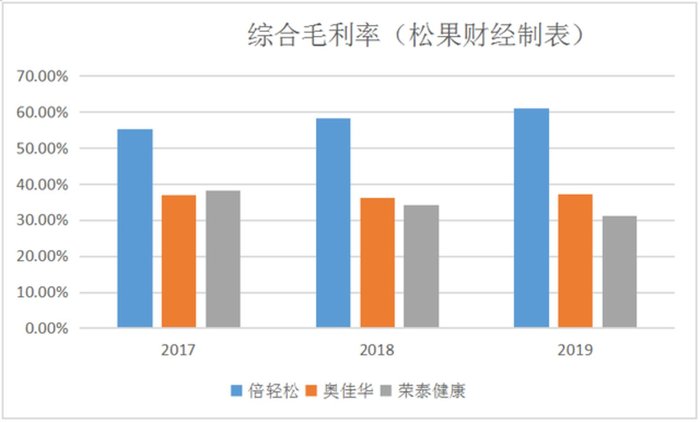
During the reporting period, Breo’s comprehensive gross margin was 55.29%, 58.19%, and 60.93% respectively, increasing yearly. In comparison, the industry leader OGAWA had gross margins of 37.00%, 36.26%, and 37.22% over the past three years, while listed company Rongtai Health recorded gross margins of 38.22%, 34.07%, and 31.28%.
Clearly, Breo has seized the initiative in portable massagers, with strong revenue and high performance, all of which justify its IPO timing. Moreover, Breo aligns with both the health and technology trends, making it a favorite among capital markets.
Moreover, as most players in the industry have yet to establish themselves, Breo’s early listing will allow it to leverage capital and further solidify its position. But is everything really “easy” for Breo?
Heavy marketing, asset-lite model — Breo's future is not so easy
On the matter of "selling massagers," Breo adopts an "asset-lite" model that relies mainly on commissioned processing supplemented by independent production, selling goods to end consumers through direct and distribution channels. The business model is simple and lightweight, but compared to other massage companies, Breo faces no shortage of operational issues.
(1) Marketing expenditure far outweighs R&D, lacking in technological substance. Although Breo claims to be a tech company, its financial input into R&D is far less than marketing. From 2017 to 2019, Breo’s R&D expenses were 18.66 million yuan, 25.58 million yuan, and 40.66 million yuan respectively, with R&D expense ratios of 5.22%, 5.04%, and 5.86%.
In contrast, Breo’s sales expenses during the same period were 129 million yuan, 183 million yuan, and 287 million yuan, totaling 599 million yuan, which is seven times its R&D expenditure, and the sales expense ratio has shown an obvious upward trend. Compared with peers, OGAWA’s sales expense ratio from 2017-2019 was only 18.94%, 18.29%, and 19.73%, while Rongtai Health’s sales expense ratio over the past three years stood at 13.73%, 12.35%, and 11.51%.
Sales expenses also compress net profit margins. Despite a gross margin far exceeding peers, Breo’s net margin still lags. According to the data, Breo’s net margin during the reporting period was 5.74%, 8.88%, and 7.89%, while Rongtai’s was 11.81%, 10.89%, and 12.45%.
Notably, in 2019 Breo’s sales staff accounted for 71.19% of total employees. OGAWA and Rongtai Health had sales personnel ratios of only 16.87% and 16.39% respectively (more than four times lower than Breo), while Breo’s R&D staff accounted for less than 10%.
(2) Relying solely on marketing to drive growth, Breo's growth rate is slowing. In terms of revenue, Breo’s operating revenue growth rates from 2017 to 2019 were 42.3% and 36.6%, showing a clear deceleration, while net margin is significantly lower than the gross margin of around 60%. The "magic" of marketing is visibly fading.
(3) Offline business has been hit by the pandemic, while online development is unfavorable. The pandemic impeded offline massage stores; Breo’s offline sales channels located in airports, high-speed rail stations and mid-to-high-end shopping malls in cities like Beijing, Shanghai and Guangzhou were obstructed. A series of pandemic control measures led to a sharp decline in direct-store sales revenue, adversely affecting the company’s 2020 operating results.
To relieve pressure, Breo moved online, but it has lost the first-mover advantage in the online space, and the results have not been ideal.
(4) Inventory turnover is slowing, posing a high risk of impairment. Another point worth noting is that inventory turnover is an important indicator of a company’s operational efficiency, reflecting product competitiveness and the ability to precisely balance supply and demand. Breo’s inventory turnover is slowing.
From 2017 to 2019 and the first half of 2020, Breo’s inventory turnover ratios were 3.7, 3.41, 2.94, and 1.28 respectively, showing a year-on-year decrease. Accumulated inventory affects Breo’s liquidity and brings considerable impairment risk.
How to quickly convert warehouse products into cash and reduce bad debt risk is something Breo needs to think about. So will IPO fundraising bring an “easy” path for Breo?
Insufficient technology investment, how should Breo position itself in the future?
With the increase in sub-healthy populations and rising health consciousness, China’s massager market has developed rapidly in recent years. According to data from the Prospective Industry Research Institute, from 2010 to 2019, the size of China’s massager market increased from 4.9 billion yuan to 13.9 billion yuan, representing a CAGR of 12.3%.
Breo has long positioned itself as a "high-tech enterprise," but its investment in technology remains insufficient. How much technology is there really in massage devices? Is it just using the tech label to harvest consumers?
As mentioned earlier, Breo’s R&D investment is far lower than its sales expenditure, making Breo look more like a marketing-driven company rather than one that builds competitive barriers through technological strength. It must be noted that for consumers, although Breo emphasizes intelligent operation, convenient use and comfort, the actual user experience is not always positive, with some saying Breo massagers are not as good as claimed.
Moreover, as a leading enterprise in China’s intelligent portable massager field, Breo has repeatedly faced product quality issues. According to a review by China-IEC, Breo and its subsidiaries were cited several times during the reporting period, including penalties from market supervision authorities.
According to information released by the Dongguan Market Supervision Bureau in June this year, Breo’s 3D kneading massage shawl did not meet national standards and was ordered to stop production and fined 89,100 yuan. Additionally, in September 2018, a quality supervision random inspection report on small massagers issued by the Shanghai Quality and Technical Supervision Bureau showed that Breo’s meridian massager failed for safety performance, with the main failing item being structure, resulting in it being listed as non-compliant.
Low product barriers, plenty of players on the track. As of March this year, the number of active massager enterprises in China had reached 3,375, with intensifying competition. Breo’s "technology density" is insufficient; it has not yet built a moat.
Companies with supply chain resources can also produce similar products. OGAWA and Rongtai Health have long been watching this space. In addition, small appliance company Bear Electric has also launched related products, with new entrants increasing continuously.
Large markets have attracted tech giants into the track. Internet players such as JD-ZAO, NetEase Yanxuan, and Xiaomi Youpin have entered the portable massager field. Xiaomi Youpin already offers portable massagers that can be controlled via the Mi Home app; JD-ZAO has launched products for eyes, scalp, neck, cervical spine, waist, feet, and more.
Moreover, in terms of price, these giants’ small massage appliances are mostly priced between 200-400 RMB, offering higher cost-performance. More notably, according to a GF Securities research report, in the massager industry, consumer brand awareness is relatively vague. Thus, Breo, as a first mover in portable massagers, has no obvious advantage.
Faced with this situation, how should Breo respond? As a leading portable massager player, Breo will continue to enjoy industry tailwinds for some time, but to achieve sustained profitability, it must increase technology investment and become a truly recognized intelligent portable massager expert.
Prosperity that relies solely on marketing will soon collapse. When companies with supply chain resources and "built-in traffic" enter the portable massager sector, Breo’s future could be precarious. How to build a strong product moat is something Breo needs to constantly consider.


